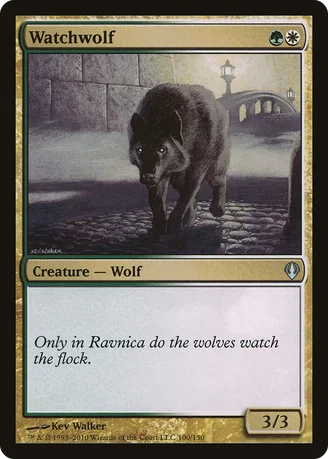
For the price your paying, this is a great cost effective creature. Whats funner is tossing an armadillo cloakon him the next turn and swinging with a 5/5 trample+lifelink.
i like wolfs and this is one of the greatest by far! 5/5 gray leotau is similar btw
Shadoflaam
★★★★★ (5.0/5.0)(13 votes)
@Flavor Text: Yeah but in Soviet Russia Wolf guards flock from dogs
DacenOctavio
★★★★☆ (4.0/5.0)(2 votes)
@ TDL:
As long as we're playing with Ravnica cards, why not kick it up a notch? If you're in Legacy or Modern, at least run Shocklands. And, 9 out of the 10 available fetchlands fetch Zoo shocklands.
This card is very good for the curve, but I think it's been outclassed now by Call of the Conclave, as you can do more with tokens these days than you can with regular creatures.
We need more things like this. Efficient vanilla creatures rock. Can we have Muraganda block already?
omni8000
☆☆☆☆☆ (0.0/5.0)
I don't know if I get the flavor text since ravnica is all city how are there fields for sheep to graze on? I mean look at the art, he's wandering a city. No field, no sheep. Does ravnica even have sheep?
i think it's a metaphor for the public/guildless. selesnya did a lot of nasty stuff to them in the original ravnica. so the idea is that if you make them angry...
Warjam
☆☆☆☆☆ (0.0/5.0)
Gatsaf Shepherd and this guy team up to make the most ironic group of flock-watchers.
LordRandomness
☆☆☆☆☆ (0.0/5.0)
WHO'S A GOOD BOY
Zebra_Lord
☆☆☆☆☆ (0.0/5.0)
So Theros just got a card that's Watchwolf....but with an added effect.
It's clear that Kalonian Tusker and Watchwolf are very similar creatures, but which card is easier to cast? Honestly, it all depends on your decktype.
Disclaimer: Keep in mind that the example decks below will be working in a vacuum, so they're basically just 24-card decks where every card is a land - the Tusker and Wolf are in your hand by default. Although having such controlled circumstances might make all of this seem insignificant, the purpose of these examples is to illustrate which of the two 3/3 creatures would be better under each manabase listed here. I believe that the results should be transferable to an actual 60-card deck because both the Tusker and the Wolf would be under the same probability disadvantages caused by having other cards in the deck with them. Somebody please correct me on this if I'm wrong, probability isn't my best or favourite field of math.
Obviously, a monogreen deck running 24 Forests is going to have an easier time with the Tusker's {G}{G} cost than the Wolf's {G}{W} cost, since any combination of two lands from that deck will be able to cast the Tusker, and no combination of two lands will be able to cast the Wolf. But what about a multicoloured deck where either card is a potential two-drop?
Let's start simple with a basic Selesnya manabase: 12 Forests and 12 Plains. Assuming your opening hand contains two lands (plus the Tusker and Wolf), here are the possibilities:
#1 - Forest, Forest: The Tusker is castable, the Wolf is not. (Score: 1/0 for the Tusker) #2 - Plains, Plains: Neither the Tusker nor the Wolf are castable. (Score: 1/0 for the Tusker) #3 - Forest, Plains: The Tusker is not castable, but the Wolf is. (Score: 1/1 Tie) #4 - Plains, Forest: The Tusker is not castable, but the Wolf is. (Final Score: 1/2 for the Wolf)
It's interesting to note that the odds of scenarios #1 or #2 happening are slightly lower than the odds of scenarios #3 or #4 happening. This is because drawing your second Forest or Plains is less likely once you've already taken one of the desired lands from the deck. On the contrary, finding a Plains after your first Forest or a Forest after your first Plains is more likely because the unwanted land has become less common in the deck. With this in mind, the Watchwolf's chances of being castable here on Turn 2 are actually slightly higher than the 50% "coin toss" chance that you might expect.
Now let's try a more developed manabase: 8 Forests, 8 Plains, 8 Temple Gardens. Assuming that having 8 Temple Gardens is even legal here, and that your opening hand contains two lands (plus the Tusker and Wolf), here are the possibilities:
#1 - Forest, Forest: The Tusker is castable, the Wolf is not. (Score: 1/0 for the Tusker) #2 - Plains, Plains: Neither the Tusker nor the Wolf are castable. (Score: 1/0 for the Tusker) #3 - Temple Garden, Temple Garden: Both the Tusker and the Wolf are castable. (Score: 2/1 for the Tusker) #4 - Forest, Plains: The Tusker is not castable, but the Wolf is. (Score: 2/2 Tie) #5 - Plains, Forest: The Tusker is not castable, but the Wolf is. (Score: 2/3 for the Wolf) #6 - Forest, Temple Garden: Both the Tusker and the Wolf are castable. (Score: 3/4 for the Wolf) #7 - Temple Garden, Forest: Both the Tusker and the Wolf are castable. (Score: 4/5 for the Wolf) #8 - Plains, Temple Garden: The Tusker is not castable, but the Wolf is. (Score: 4/6 for the Wolf) #9 - Temple Garden, Plains: The Tusker is not castable, but the Wolf is. (Final Score: 4/7 for the Wolf)
Like in the Basic Selesnya example above, the Wolf gets a slight probability advantage over the Tusker due to the inherent difficulty associated with drawing multiples of a desired card. On top of this, it is very clear that the Wolf gathers more of an advantage from the use of dual lands than the Tusker does here.
TL;DR
If you're using a nonwhite deck or Beast Tribal or just something very green-heavy, go with Kalonian Tusker. Otherwise, use Watchwolf; it's much easier to cast and has better flavour all around.
Comments (33)
why would you do that, wizards ;__;
5/5
Turn two: Plains, Watchwolf.
Turn Three: Mountain, Wooly Thoctar.
Turn Four: Forest, Ranger of Eos, fetching two Wild Nacatls.
Zoo can get crazy if it doesn't miss its land drops.
Love cards like this! <3
gray leotau is similar btw
As long as we're playing with Ravnica cards, why not kick it up a notch? If you're in Legacy or Modern, at least run Shocklands. And, 9 out of the 10 available fetchlands fetch Zoo shocklands.
Turn 1: Wooded Foothills, Arid Mesa, or Windswept Heath into Sacred Foundry or Stomping Ground, cast Goblin Guide.
Turn 2: Repeat of Turn 1's shenanigans into Watchwolf or Qasali Pridemage.
Turn 3: Repeat of land shenanigans, Wild Nacatl, Kird Ape, or Loam Lion plus kicked Goblin Bushwhacker. Your opponent may now concede.
green has cost-efficient creatures
white has cost-efficient creatures at low p/t
this guy. yes.
They did. It's called Call of the Conclave.
i think it's a metaphor for the public/guildless. selesnya did a lot of nasty stuff to them in the original ravnica. so the idea is that if you make them angry...
http://mythicspoiler.com/ths/cards/fleecemanelion.html
Unflinching Courage
5/5
And yes, Kalonian Tusker is great too.
Disclaimer: Keep in mind that the example decks below will be working in a vacuum, so they're basically just 24-card decks where every card is a land - the Tusker and Wolf are in your hand by default. Although having such controlled circumstances might make all of this seem insignificant, the purpose of these examples is to illustrate which of the two 3/3 creatures would be better under each manabase listed here. I believe that the results should be transferable to an actual 60-card deck because both the Tusker and the Wolf would be under the same probability disadvantages caused by having other cards in the deck with them. Somebody please correct me on this if I'm wrong, probability isn't my best or favourite field of math.
Monogreen
(Kalonian Tusker Casting Odds: 100%, Watchwolf Casting Odds: 0%)
Obviously, a monogreen deck running 24 Forests is going to have an easier time with the Tusker's {G}{G} cost than the Wolf's {G}{W} cost, since any combination of two lands from that deck will be able to cast the Tusker, and no combination of two lands will be able to cast the Wolf. But what about a multicoloured deck where either card is a potential two-drop?
Basic Selesnya
(Kalonian Tusker Casting Odds: 23.91%, Watchwolf Casting Odds: 52.17%)
Let's start simple with a basic Selesnya manabase: 12 Forests and 12 Plains. Assuming your opening hand contains two lands (plus the Tusker and Wolf), here are the possibilities:
#1 - Forest, Forest: The Tusker is castable, the Wolf is not. (Score: 1/0 for the Tusker)
#2 - Plains, Plains: Neither the Tusker nor the Wolf are castable. (Score: 1/0 for the Tusker)
#3 - Forest, Plains: The Tusker is not castable, but the Wolf is. (Score: 1/1 Tie)
#4 - Plains, Forest: The Tusker is not castable, but the Wolf is. (Final Score: 1/2 for the Wolf)
It's interesting to note that the odds of scenarios #1 or #2 happening are slightly lower than the odds of scenarios #3 or #4 happening. This is because drawing your second Forest or Plains is less likely once you've already taken one of the desired lands from the deck. On the contrary, finding a Plains after your first Forest or a Forest after your first Plains is more likely because the unwanted land has become less common in the deck. With this in mind, the Watchwolf's chances of being castable here on Turn 2 are actually slightly higher than the 50% "coin toss" chance that you might expect.
Dual Selesnya
(Kalonian Tusker Casting Odds: 42.63%, Watchwolf Casting Odds: 79.29%)
Now let's try a more developed manabase: 8 Forests, 8 Plains, 8 Temple Gardens. Assuming that having 8 Temple Gardens is even legal here, and that your opening hand contains two lands (plus the Tusker and Wolf), here are the possibilities:
#1 - Forest, Forest: The Tusker is castable, the Wolf is not. (Score: 1/0 for the Tusker)
#2 - Plains, Plains: Neither the Tusker nor the Wolf are castable. (Score: 1/0 for the Tusker)
#3 - Temple Garden, Temple Garden: Both the Tusker and the Wolf are castable. (Score: 2/1 for the Tusker)
#4 - Forest, Plains: The Tusker is not castable, but the Wolf is. (Score: 2/2 Tie)
#5 - Plains, Forest: The Tusker is not castable, but the Wolf is. (Score: 2/3 for the Wolf)
#6 - Forest, Temple Garden: Both the Tusker and the Wolf are castable. (Score: 3/4 for the Wolf)
#7 - Temple Garden, Forest: Both the Tusker and the Wolf are castable. (Score: 4/5 for the Wolf)
#8 - Plains, Temple Garden: The Tusker is not castable, but the Wolf is. (Score: 4/6 for the Wolf)
#9 - Temple Garden, Plains: The Tusker is not castable, but the Wolf is. (Final Score: 4/7 for the Wolf)
Like in the Basic Selesnya example above, the Wolf gets a slight probability advantage over the Tusker due to the inherent difficulty associated with drawing multiples of a desired card. On top of this, it is very clear that the Wolf gathers more of an advantage from the use of dual lands than the Tusker does here.
TL;DR
If you're using a nonwhite deck or Beast Tribal or just something very green-heavy, go with Kalonian Tusker. Otherwise, use Watchwolf; it's much easier to cast and has better flavour all around.