It's like a mini-Fact or Fiction. I prefer the oldschool choice more, though.
Omenchild
★★☆☆☆ (2.8/5.0)(5 votes)
I like this haha it's more fair, and it leaves for more mind-games. Plus it's cheaper to buy haha.
Megrimage
★★★★☆ (4.3/5.0)(3 votes)
it is fun... simple as that. you can run 4 of those, and they make it easy to get land when you need it. it is recommended to play with 1 copy of fact or fiction and 1 copy of gifts ungiven.
cathode01
★★★☆☆ (3.0/5.0)(3 votes)
Since both this and Fact or Fiction depend on your opponent's knowledge of your deck and their general skill at Magic, I would say that this card is even better than the "classic".
BegleOne
★★★★★ (5.0/5.0)(1 vote)
It's not even close in power to Fact or Fiction. If you only need one card out of the top five, this is better than FoF. But usually FoF would get you an extra card or two. And even more importantly in many of the decks it was played against, FoF would send the unselected cards to the graveyard.
Psychatog wouldn't have been nearly as good if it had to rely on this over Fact or Fiction.
scumbling1
★★★★☆ (4.3/5.0)(3 votes)
If I had to play a two-mana cantrip, I'd still use Impulse. You'll be picking from four cards rather than 2.5.
Kryptnyt
☆☆☆☆☆ (0.0/5.0)
It's a lot more difficult to get the card you want, too.
Purple_Shrimp
☆☆☆☆☆ (0.7/5.0)(5 votes)
this should have cost 1uu and given you the whole pile
LordRandomness
★★★★★ (5.0/5.0)(1 vote)
I generally prefer Telling Time: In exchange for looking at 2 less cards, you get all the choice and more options besides.
Lash_of_Dragonbreath
☆☆☆☆☆ (0.5/5.0)(2 votes)
You guys are completely misunderstanding this card. It's not a Fact of Fiction. It's a self-milling Tome Scour that lets you keep a card.
bowlofgumbo
☆☆☆☆☆ (0.0/5.0)
Self-milling Tome-Scour? The unchosen cards go back in your library homie o_O
Chamale
★★★★★ (5.0/5.0)(1 vote)
The best way to play this is to put the best card in one pile and all 4 in the others. If your opponent chooses the small pile, you get the best card, and otherwise you get the second-best card out of the top 5. It's not Impulse good but still good. Don't play it in a combo deck, because your opponent can bury your combo piece, just play it in a deck with a lot of useful effects.
wholelottalove
☆☆☆☆☆ (0.0/5.0)
Like Truth or Fictionbut much less mana and not as good a card draw. With this card the cards not chosen don't go into the gyard though. I would say run both of these.
Missile_Penguin
★★★★★ (5.0/5.0)(2 votes)
Each Time Spiral card was an homage to at least one previously printed card.
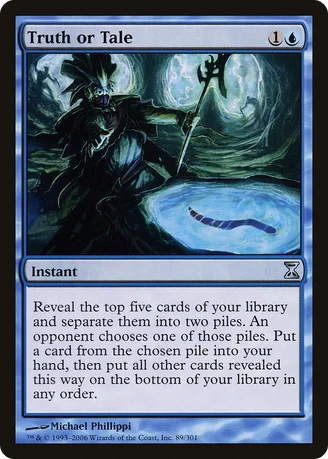
The card references Fact or Fiction, one of the most powerful card draw spells ever printed, which was itself part of a cycle of cards requiring separation of objects into two piles: Bend or Break, Death or Glory, Do or Die, Fight or Flight, and Stand or Fall (strangely there were two red and two white parts to this card series and no green parts). One difference that set Fact or Fiction apart (and made it so powerful) was that you were allowed to make the decision between the piles, not your opponent. Truth or Tale rectifies this and therefore created a much weaker card.
Ragamander
☆☆☆☆☆ (0.0/5.0)
This card got a conceptual reprint in Theros: Steam Augury. Same process at twice the cost, but you get the whole pile. I assume much of the strategy for optimal use of Truth or Tale will extend to Steam Augury.
When playing against Truth or Tale, you should know that the more options your opponent has, the worse it is for you, all else being equal. In any random 2:3 or 1:4 split, letting your opponent pick from the bigger pile is a mistake. However, your opponent probably knows that you won't let him/her have the pick of a bigger litter, and so will make the smaller litter more desirable. So, generally, your opponent will split the card he/she wants most and the card he/she wants second-most into separate piles.
There are two options for the split - 2:3 and 1:4. The 2:3 split is actually the harder one to deal with, since it gives you the least information about how your opponent values each card. (A 1:4 split typically indicates that the pile of one contains a relatively good card: probably the best or second-best of the five.)
When playing Truth or Tale yourself, you'll probably find that it is pretty risky. Since it's hard to trick your opponent into letting you select from the pile you put the best card into, you basically always get the second-best card. So, on the one hand, you'll almost never get the card you need most. On the other hand, however, the second-best out of five is generally better than a random top-deck. Here's why: Before seeing what they are, you generally have to assume that the top five cards make up a representative sample of your deck, in that they have the same average usefulness as your deck in general. If we also assume an even distribution of usefulness (which might be unfair, mainly because the usefulness of drawing lands is wildly variable depending on the game state), then the median and the mean will be equal, meaning that, in general, the third-best card of the top-five will be about as useful as any randomly-selected card in your deck. Since you usually get the second-best card of the top five from Truth or Tale, it's a bit better than a random topdeck.
However, a random topdeck is just "Draw a card," and you don't even want to pay for just that. Paying for something that's probably only a bit better than a random top-deck is dubious at best. According to my calculations (I am not making this up), it's a little weaker than Serum Visions at twice the cost but at instant speed. Whether that speed is generally worth the high cost and low effect depends on your deck and your opponent's deck.
And, of course, nothing quite beats the look on your opponent's face when, late in the game, they tap out for Plated Slagwurm and you respond with Truth or Tale, leaving three islands untapped, and revealing a single copy of Dissolve and a single copy of Frost Titan among the five. You split those two; they know you'll counter their spell if they let you have Dissolve, and they know the Slagwurm outraces the Titan, so they reluctantly give you the pile with the Frost Titan in it...and then you cast Mana Leak out of your hand and counter the Slagwurm anyways.
Of course, there are situations when this is a little more useful than usual. If you desperately need either any land (i.e. if you're mana-screwed) or any nonland card (i.e. if you're mana-flooded), there's a fair chance this will get you what you need faster/more reliably than, say, Divination, which is the baseline, run-of-the-mill draw spell. After all, if 40% of your deck is land, you'll most likely hit two lands and three nonlands, which you can split to get either type.
If you get too few of the kind of card you need to put them in both piles, you can try to bluff your opponent: separate the cards in a 1:4 ratio, putting the single best card of the type you DON'T want in one pile and the rest (including the card you actually want) in the other pile. If your opponent doesn't know what you need, they'll probably assume the card you want the most is in the pile with only one card in it, and they'll let you pick from the pile of four, which has the card you ACTUALLY want!
If even that fails, at least you just got rid of four relatively useless cards, improving your odds on subsequent draws.
Comments (15)
I prefer the oldschool choice more, though.
Psychatog wouldn't have been nearly as good if it had to rely on this over Fact or Fiction.
It's not a Fact of Fiction. It's a self-milling Tome Scour that lets you keep a card.
The card references Fact or Fiction, one of the most powerful card draw spells ever printed, which was itself part of a cycle of cards requiring separation of objects into two piles: Bend or Break, Death or Glory, Do or Die, Fight or Flight, and Stand or Fall (strangely there were two red and two white parts to this card series and no green parts). One difference that set Fact or Fiction apart (and made it so powerful) was that you were allowed to make the decision between the piles, not your opponent. Truth or Tale rectifies this and therefore created a much weaker card.
When playing against Truth or Tale, you should know that the more options your opponent has, the worse it is for you, all else being equal. In any random 2:3 or 1:4 split, letting your opponent pick from the bigger pile is a mistake. However, your opponent probably knows that you won't let him/her have the pick of a bigger litter, and so will make the smaller litter more desirable. So, generally, your opponent will split the card he/she wants most and the card he/she wants second-most into separate piles.
There are two options for the split - 2:3 and 1:4. The 2:3 split is actually the harder one to deal with, since it gives you the least information about how your opponent values each card. (A 1:4 split typically indicates that the pile of one contains a relatively good card: probably the best or second-best of the five.)
When playing Truth or Tale yourself, you'll probably find that it is pretty risky. Since it's hard to trick your opponent into letting you select from the pile you put the best card into, you basically always get the second-best card. So, on the one hand, you'll almost never get the card you need most. On the other hand, however, the second-best out of five is generally better than a random top-deck. Here's why:
Before seeing what they are, you generally have to assume that the top five cards make up a representative sample of your deck, in that they have the same average usefulness as your deck in general. If we also assume an even distribution of usefulness (which might be unfair, mainly because the usefulness of drawing lands is wildly variable depending on the game state), then the median and the mean will be equal, meaning that, in general, the third-best card of the top-five will be about as useful as any randomly-selected card in your deck. Since you usually get the second-best card of the top five from Truth or Tale, it's a bit better than a random topdeck.
However, a random topdeck is just "Draw a card," and you don't even want to pay
And, of course, nothing quite beats the look on your opponent's face when, late in the game, they tap out for Plated Slagwurm and you respond with Truth or Tale, leaving three islands untapped, and revealing a single copy of Dissolve and a single copy of Frost Titan among the five. You split those two; they know you'll counter their spell if they let you have Dissolve, and they know the Slagwurm outraces the Titan, so they reluctantly give you the pile with the Frost Titan in it...and then you cast Mana Leak out of your hand and counter the Slagwurm anyways.
Of course, there are situations when this is a little more useful than usual. If you desperately need either any land (i.e. if you're mana-screwed) or any nonland card (i.e. if you're mana-flooded), there's a fair chance this will get you what you need faster/more reliably than, say, Divination, which is the baseline, run-of-the-mill draw spell. After all, if 40% of your deck is land, you'll most likely hit two lands and three nonlands, which you can split to get either type.
If you get too few of the kind of card you need to put them in both piles, you can try to bluff your opponent: separate the cards in a 1:4 ratio, putting the single best card of the type you DON'T want in one pile and the rest (including the card you actually want) in the other pile. If your opponent doesn't know what you need, they'll probably assume the card you want the most is in the pile with only one card in it, and they'll let you pick from the pile of four, which has the card you ACTUALLY want!
If even that fails, at least you just got rid of four relatively useless cards, improving your odds on subsequent draws.