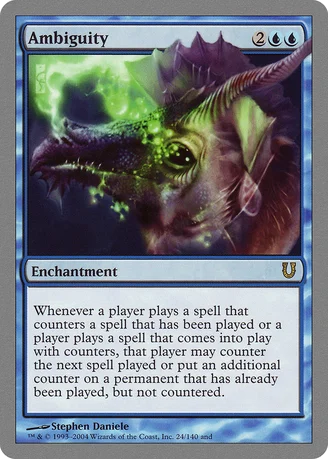
Whenever a player plays a counterspell or a spell that comes into play with counters on it, that player may either counter the next spell played or put a counter on a permanent.
It's not entirely Magic syntax, but it's legible. Enjoy.
Roxolan
★★☆☆☆ (2.1/5.0)(4 votes)
This could be great in a counterspell deck. 2UU each counterspell you play is twice as effective? Count me in.
If I can get my hands on a copy, I'll also try it in Limited Infinity.
Waffle_of_Bolas
★★☆☆☆ (2.2/5.0)(3 votes)
Who?
Mafoo
★★★★☆ (4.0/5.0)(4 votes)
lolwut
Drecon84
★★★★☆ (4.2/5.0)(5 votes)
It doesn't specify the kind of counters. Time to get creative!
BelloAbril
★★☆☆☆ (2.2/5.0)(3 votes)
*** goes where?
Gezus82
★★★☆☆ (3.9/5.0)(5 votes)
Who/What/When/Where/Why?
Marandil
★★★★☆ (4.2/5.0)(5 votes)
Oh yeah... counter a spell and put an additional couner on quest... or on a planeswalker... or on a ...
Nimeon
★★☆☆☆ (2.0/5.0)(1 vote)
It won't work with quests; they don't enter the battlefield with counters.
A3Kitsune
☆☆☆☆☆ (0.0/5.0)
It works with quests. It doesn't trigger off them being played, but it'll put counters on them when it does trigger.
Hmm, Divinity counters...
Azymth
☆☆☆☆☆ (0.5/5.0)(1 vote)
This card explains perfectly why I hate blue. I want a white enchantment for 1W that automatically counters any card coming in to play with more than one sentence of explanation text.
TOF1000
★★★☆☆ (3.0/5.0)(2 votes)
confusing but powerful, i like it
achilleselbow
☆☆☆☆☆ (0.0/5.0)
Actually not that difficult to understand. The "may counter next spell" ability would mainly be a way to slow down your opponent, since he'd just wait for you to cast your next spell before casting anything himself (or play some minor spell before playing the one he really wanted to play). And "permanent that has already been played, but not countered" is the same as just saying "permanent," lol.
GrimjawxRULES
☆☆☆☆☆ (0.0/5.0)
Umm... Graft, anyone?
therealnick103
☆☆☆☆☆ (0.0/5.0)
I play "Ambiguity"!! (reads ability really fast) Now, you got all that? Because I'm not repeating it.
SpencerDub
★★★★☆ (4.0/5.0)(3 votes)
Now that some terminology has been shifted, a "deciphered" version might read something like this:
"Whenever a player casts a spell that counters a spell or casts a spell that enters the battlefield with counters on it, that player may either counter the next spell cast or put an additional counter of any type on a permanent."
I tried to get close to Magic syntax as it is today, but it may be off by a little bit.
yesnomu
★★★★★ (5.0/5.0)(16 votes)
Look at it upside-down.
divine_exodus
☆☆☆☆☆ (0.5/5.0)(1 vote)
So...many....counters....can't....understand....
ROBRAM89
★★★★☆ (4.0/5.0)(2 votes)
I wish this were a "real" card, because my UW proliferate/level up deck could use this.
Stray_Dog
★★☆☆☆ (2.0/5.0)(1 vote)
@yesnomu - woah!
Hayw00d0909
☆☆☆☆☆ (0.5/5.0)(2 votes)
*shoots self out of confusion*
Risenguy
★☆☆☆☆ (1.0/5.0)(1 vote)
Ummmmmmmmmm What?
TrueBloodWolf
☆☆☆☆☆ (0.0/5.0)
So basically... If I counter a card or play a card that put's counter's on it, I can either counter the next spell, or put another counter on a target creature?
majinara
☆☆☆☆☆ (0.0/5.0)
Fun fact: Click on "details" and then on the small blow arrow next to the card, twice, so the card is upside down. SURPRISE! :D
fourk
★★★★☆ (4.9/5.0)(4 votes)
I'm fairly certain that the examples provided by user @Bandswithother are incorrect, as they do not take mechanics of the stack into account.
Revised example: P1: "I cast Ambiguity, you may go." P2: "I cast disenchant on your end step." P1: "In response, Counterspell." P1: "Note that, by placing Counterspell on the stack, I have triggered the ability of ability of Ambiguity. Does this ability resolve?" now, there are four ways that this can play out from here.
Way 1: P2: "In response to Ambiguity's triggered ability, I play another Disenchant." order of resolution: 2nd Disenchant, then Ambiguity's triggered ability, then Counterspell (removing first Disenchant from the stack)
Way 2/3/4: P2: "Yes, I will let it resolve." Way 2: P1:"I choose to counter the next spell played this turn." OR Way 3: P1:"I choose to place a counter on a permanent that is already in play and already has at least one counter on it. The counter is of a type that the permanent already has one or more counters of that type on it.(if a permanent has -1/-1 counters and +1/+1 counters, for example, you may choose to put one counter of either type on the permanent)" OR Way 4: P1: "I choose not to use this ability, on the basis of the word 'may' in the card text."
The one issue that I'm unsure of, is how to interpret "that has already been played, but not countered" part of determining a valid permanent to put an additional counter on. I'd imagine that this means that if I were to discard a Spike Drone then play Reanimate to bring that Spike Drone into play, it would not be a valid recipient of a counter from Ambiguity. However, if I had played the Spike Drone, then used its ability (thus killing it as a state based effect), then Reanimated it, it would be a valid recipient. If I had attempted to play Spike Drone, had it counterspelled, then used Reanimate to put it in play, it would also not be a valid recipient.
Also, note that Ambiguity only triggers (for the counterspell trigger) when someone plays a counter spell targetting a spell that was PLAYED, not copied. Playing a counter on a Storm copy, Fork copy, Conspire copy, etc, would not trigger it.
None of the "simplified/deciphered" versions of the text in this thread come close to actually fully encompassing the card as worded in the Oracle text. 'Ambiguity' doesn't really describe this card so much as 'overly complicated'.
Bandswithother
★★★★☆ (4.2/5.0)(5 votes)
Another way of putting it to the confused: whenever you or an opponent plays a counter spell, they get an optional free counter spell for the next spell played. OR if you play a card that comes into play with counters on it (like a planeswalker) you may put an additional counter on another planeswalker or a Zendikar quest (much like proliferate, but for only one permanent).
Both of these effects work interchangeably too. You can cast a planeswalker and counter the next spell played or you can counter a spell and put another counter on your walker.
Errata: Fourk is correct, I changed my first example to reflect it. However my other examples are perfectly fine.
Examples:
P1: "I cast Ambiguity, you may go." P2:"I disenchant it on your end step." "Counterspell." "Fine. Untap. Draw. Oh another Disenchant, now I'll blow up your Ambiguity." "I counter it." "But you're tapped out." "Read Ambiguity again."
P1: "I cast Sorin Markov and drop your life to 10" P2: "I Bolt him." "I counter it." "But you don't have any cards in your hand!" "Read Ambiguity again."
P2: "I cast Unmake." P1: "I counter it, and put another -1/-1 counter on your bloodied ghost." "what?" "Read Ambiguity again."
P2: "I cast Bloodied Ghost, and put another Loyalty counter on my Elspeth" P1: "Now you're learning!"
slathbog3000
☆☆☆☆☆ (0.0/5.0)
Since it doesn't specify the type of counter can you put a +99999/+99999 counter on your Spikeshot Elder that already has a +1/+1 counter from some ability?
DarthParallax
☆☆☆☆☆ (0.0/5.0)
So, I'm assuming that putting this card into a Knowledge Pool is considered...how you say...'a really dick move?'
DoragonShinzui
☆☆☆☆☆ (0.0/5.0)
Errata: If you can read the full rules text of this card without stuttering, counter target counter.
j_mindfingerpainter
☆☆☆☆☆ (0.0/5.0)
wut
Haelthor
☆☆☆☆☆ (0.0/5.0)
One of my favorite Un cards ever! I'm looking to get this for my Cube draft piles because it can actually be used (and not be obnoxious like many Un-cards).
This card's ability could easily be printed in a "real" set, with a higher mana cost of course. 3UU or 4UU(on a stick) seems appropriate.
Continue
☆☆☆☆☆ (0.0/5.0)
There are four possible things that may be done with this card. They are as follows:
1) A player counters a spell. a) That player may counter the next spell that is cast. b) That player may put a counter on a permanent, limited to a type of counter already on that permanent. (I assume this card follows proliferate rules, but this is Unhinged, so perhaps not.)
2) A player casts a spell that, when it resolves, enters the battlefield with counters on it — for example, a planeswalker or an Arcbound creature. a) That player may counter the next spell that is cast. b) That player may put a counter on a permanent, limited to a type of counter already on that permanent.
Hope this helps anyone who was confused about this card's functionality. Do note that you may also choose to do neither, but you would need to wait until both a spell is cast and a permanent enters the battlefield with counters to determine that you will do nothing.
Clashkill84
☆☆☆☆☆ (0.0/5.0)
Whenever you counter a spell you get to counter the next spell played for free?? AND every permanent you play comes in with an extra counter? Wow even if it is confusing this card is pretty good.
SilentOppressor
☆☆☆☆☆ (0.0/5.0)
Whenever a player plays a counterspell or a spell that comes into play with counters on it, that player may either counter the next spell played or put a counter on a permanent.
It's not entirely Magic syntax, but it's legible. Enjoy.
But not entirely correct, because it would also trigger on Lightning Storm
TheWrathofShane
★★★★★ (5.0/5.0)(2 votes)
Whenever a player counters a spell, or a player casts a spell that enters the battlefield with counters, that player may either counter the next spell cast, or put an additional counter on a permanent.
Also look at it upside down.
PopcornBunni
☆☆☆☆☆ (0.0/5.0)
I think I've nailed the wording on this using current syntax.
Whenever a player casts a spell that counters a spell on the stack or whenever a player casts a permanent spell that would cause the permanent which resolves from that spell to enter the battlefield with one or more counters on it, that player may counter the next spell played this game or choose a nonland permanent with one or more counters on it that entered the battlefield as a resolved permanent spell or a land with one or more counters on it that entered the battlefield as the result of a land play and give it another counter of a kind already there.
I don't think it makes anything less confusing at all.
Comments (39)
It's not entirely Magic syntax, but it's legible. Enjoy.
If I can get my hands on a copy, I'll also try it in Limited Infinity.
Hmm, Divinity counters...
"Whenever a player casts a spell that counters a spell or casts a spell that enters the battlefield with counters on it, that player may either counter the next spell cast or put an additional counter of any type on a permanent."
I tried to get close to Magic syntax as it is today, but it may be off by a little bit.
Click on "details" and then on the small blow arrow next to the card, twice, so the card is upside down. SURPRISE! :D
Revised example:
P1: "I cast Ambiguity, you may go."
P2: "I cast disenchant on your end step."
P1: "In response, Counterspell."
P1: "Note that, by placing Counterspell on the stack, I have triggered the ability of ability of Ambiguity. Does this ability resolve?"
now, there are four ways that this can play out from here.
Way 1:
P2: "In response to Ambiguity's triggered ability, I play another Disenchant."
order of resolution: 2nd Disenchant, then Ambiguity's triggered ability, then Counterspell (removing first Disenchant from the stack)
Way 2/3/4:
P2: "Yes, I will let it resolve."
Way 2: P1:"I choose to counter the next spell played this turn." OR
Way 3: P1:"I choose to place a counter on a permanent that is already in play and already has at least one counter on it. The counter is of a type that the permanent already has one or more counters of that type on it.(if a permanent has -1/-1 counters and +1/+1 counters, for example, you may choose to put one counter of either type on the permanent)" OR
Way 4: P1: "I choose not to use this ability, on the basis of the word 'may' in the card text."
The one issue that I'm unsure of, is how to interpret "that has already been played, but not countered" part of determining a valid permanent to put an additional counter on. I'd imagine that this means that if I were to discard a Spike Drone then play Reanimate to bring that Spike Drone into play, it would not be a valid recipient of a counter from Ambiguity. However, if I had played the Spike Drone, then used its ability (thus killing it as a state based effect), then Reanimated it, it would be a valid recipient. If I had attempted to play Spike Drone, had it counterspelled, then used Reanimate to put it in play, it would also not be a valid recipient.
Also, note that Ambiguity only triggers (for the counterspell trigger) when someone plays a counter spell targetting a spell that was PLAYED, not copied. Playing a counter on a Storm copy, Fork copy, Conspire copy, etc, would not trigger it.
None of the "simplified/deciphered" versions of the text in this thread come close to actually fully encompassing the card as worded in the Oracle text. 'Ambiguity' doesn't really describe this card so much as 'overly complicated'.
Both of these effects work interchangeably too. You can cast a planeswalker and counter the next spell played or you can counter a spell and put another counter on your walker.
Errata: Fourk is correct, I changed my first example to reflect it. However my other examples are perfectly fine.
Examples:
P1: "I cast Ambiguity, you may go."
P2:"I disenchant it on your end step."
"Counterspell."
"Fine. Untap. Draw. Oh another Disenchant, now I'll blow up your Ambiguity."
"I counter it."
"But you're tapped out."
"Read Ambiguity again."
P1: "I cast Sorin Markov and drop your life to 10"
P2: "I Bolt him."
"I counter it."
"But you don't have any cards in your hand!"
"Read Ambiguity again."
P2: "I cast Unmake."
P1: "I counter it, and put another -1/-1 counter on your bloodied ghost."
"what?"
"Read Ambiguity again."
P2: "I cast Bloodied Ghost, and put another Loyalty counter on my Elspeth"
P1: "Now you're learning!"
This card's ability could easily be printed in a "real" set, with a higher mana cost of course. 3UU or 4UU(on a stick) seems appropriate.
1) A player counters a spell.
a) That player may counter the next spell that is cast.
b) That player may put a counter on a permanent, limited to a type of counter already on that permanent. (I assume this card follows proliferate rules, but this is Unhinged, so perhaps not.)
2) A player casts a spell that, when it resolves, enters the battlefield with counters on it — for example, a planeswalker or an Arcbound creature.
a) That player may counter the next spell that is cast.
b) That player may put a counter on a permanent, limited to a type of counter already on that permanent.
Hope this helps anyone who was confused about this card's functionality. Do note that you may also choose to do neither, but you would need to wait until both a spell is cast and a permanent enters the battlefield with counters to determine that you will do nothing.
It's not entirely Magic syntax, but it's legible. Enjoy.
But not entirely correct, because it would also trigger on Lightning Storm
Also look at it upside down.
Whenever a player casts a spell that counters a spell on the stack or whenever a player casts a permanent spell that would cause the permanent which resolves from that spell to enter the battlefield with one or more counters on it, that player may counter the next spell played this game or choose a nonland permanent with one or more counters on it that entered the battlefield as a resolved permanent spell or a land with one or more counters on it that entered the battlefield as the result of a land play and give it another counter of a kind already there.
I don't think it makes anything less confusing at all.