Its a pretty good card...but to be honest I don't understand the value of the errata on this card. I suppose it may seem "cheap" to bounce off an opponent's escaped shapeshifter a bunch of effects from your own keyworded cards...but honestly with the advent of cards like Cairn Wanderer I don't see how this guy is that strong anymore...definately not strong enough to warrant an errata not in line with its original functionality.
majinara
★★★☆☆ (3.5/5.0)(2 votes)
If it would get updated with each new keyard ability it would be nice. Like this? A funny card for a shapeshifter tribal, but more on the weak side.
xd4
★★★★★ (5.0/5.0)(1 vote)
i like it but... i dont see why it cost five... but i did but it in my shapsifter deck
longwinded
☆☆☆☆☆ (0.0/5.0)
@kitsunewarlock The errata is probably to avoid situations where the Escaped Shapeshifters gain abilities and never lose them. Say we both have an ES, I cast Leap on one of my creatures, your ES gains flying (at least until my creature loses it at end of turn), then my ES has flying because your ES has flying. At the end of the turn, Leap wears off, but my ES doesn't lose flying until your ES does, and your ES doesn't because I still have a flying ES. I'd have to look back at the rules when this came out (if I can find them), but the rules on temporary effects and how they wear off may have been subtly different back then, so the errata may restore original design intent.
Alternatively, this may have been a situation where someone asked "wait, was it supposed to work like that originally?" and no one could remember or give convincing answer. Since that situation is not as odd as, say, a Phantom Centaur with a Crown of Vigor being completely immune to damage-based destruction (and that's considered a feature not a bug), I'd say there's probably a reason for the errata.
SIlverSkyz
★★★★★ (5.0/5.0)(2 votes)
Well I suppose the errata makes sense.
Imagine, if you will, a game where both players have just a single copy of Escaped Shapeshifter on the battlefield. Then say a player drops a Tundra Wolves. Because this card has a threshold mechanic it would see an opponent's creature with first strike, and gain it itself. Then the other would see that an opponent's creature has first strike and would gain it (I believe this happens as a string of two state based actions). If later the Tundra Wolves leave the battlefield, the original shapeshifter would check to see if an opponent's creature still has first strike, and would see that one does and would keep it. The end result would be two Escaped Shapeshifters that both had first strike because the other one did, even though there are no other creatures on the battlefield.
One other reason (though this one seems much rarer) would be that two could cause an infinite loop. If a creature enters the battlefield, then immediately leaves it (not from an ability like evoking Mulldrifter, it sticks around long enough for both to gain flying) like if you summon a Force of Savagery. The state based actions that would occur go like this: 1. Force of Savagery enters the battlefield with zero toughness, at the point state based actions resolve it will be put into a graveyard. Escaped Shapeshifter(1) sees a creature an opponent controls has trample so it gains it when the state based actions resolve. They resolve. 2. Escaped Shapeshifter (1) no longer sees a creature with trample under it's opponent's control, so it will lose trample. Escaped Shapeshifter(2) now sees a creature an opponent controls has trample, so it will gain it. It resolves. 3.Escaped Shapeshifter(2) now doesn't see a creature with trample, so it loses the ability. Escaped Shapeshifter(1) sees trample and copies it. Repeat Ad Nauseam.
So not being able to bounce abilities from one to another is annoying, but by simply adding that errata they get rid of confusing situations where they have abilities even though the source had left, and accidentally causing a draw by doing something.
Lord_Ascapelion
★★★★★ (5.0/5.0)(1 vote)
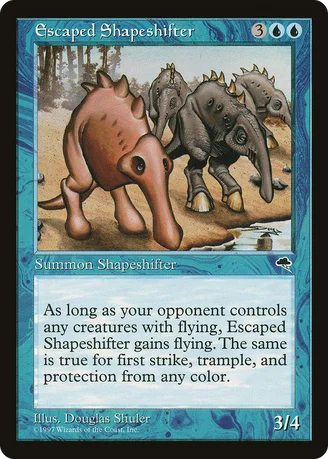
The card really isn't that great, but the art is absolutely adorable. Just something cute about a shapeshifter going in and mimicking those weird two-legged anteater elephant herd things.
TtothaOtothadoubleD
★★★★★ (5.0/5.0)(2 votes)
"Day 3: After having escaped from Volrath's Gardens, the creatures by this river are still wary of me. Perhaps if I can conjure a fifth spiny protrusion on my back, I will earn their trust completely..."
Comments (7)
The errata is probably to avoid situations where the Escaped Shapeshifters gain abilities and never lose them. Say we both have an ES, I cast Leap on one of my creatures, your ES gains flying (at least until my creature loses it at end of turn), then my ES has flying because your ES has flying. At the end of the turn, Leap wears off, but my ES doesn't lose flying until your ES does, and your ES doesn't because I still have a flying ES. I'd have to look back at the rules when this came out (if I can find them), but the rules on temporary effects and how they wear off may have been subtly different back then, so the errata may restore original design intent.
Alternatively, this may have been a situation where someone asked "wait, was it supposed to work like that originally?" and no one could remember or give convincing answer. Since that situation is not as odd as, say, a Phantom Centaur with a Crown of Vigor being completely immune to damage-based destruction (and that's considered a feature not a bug), I'd say there's probably a reason for the errata.
Imagine, if you will, a game where both players have just a single copy of Escaped Shapeshifter on the battlefield. Then say a player drops a Tundra Wolves. Because this card has a threshold mechanic it would see an opponent's creature with first strike, and gain it itself. Then the other would see that an opponent's creature has first strike and would gain it (I believe this happens as a string of two state based actions). If later the Tundra Wolves leave the battlefield, the original shapeshifter would check to see if an opponent's creature still has first strike, and would see that one does and would keep it. The end result would be two Escaped Shapeshifters that both had first strike because the other one did, even though there are no other creatures on the battlefield.
One other reason (though this one seems much rarer) would be that two could cause an infinite loop. If a creature enters the battlefield, then immediately leaves it (not from an ability like evoking Mulldrifter, it sticks around long enough for both to gain flying) like if you summon a Force of Savagery. The state based actions that would occur go like this:
1. Force of Savagery enters the battlefield with zero toughness, at the point state based actions resolve it will be put into a graveyard. Escaped Shapeshifter(1) sees a creature an opponent controls has trample so it gains it when the state based actions resolve.
They resolve.
2. Escaped Shapeshifter (1) no longer sees a creature with trample under it's opponent's control, so it will lose trample. Escaped Shapeshifter(2) now sees a creature an opponent controls has trample, so it will gain it.
It resolves.
3.Escaped Shapeshifter(2) now doesn't see a creature with trample, so it loses the ability. Escaped Shapeshifter(1) sees trample and copies it.
Repeat Ad Nauseam.
So not being able to bounce abilities from one to another is annoying, but by simply adding that errata they get rid of confusing situations where they have abilities even though the source had left, and accidentally causing a draw by doing something.