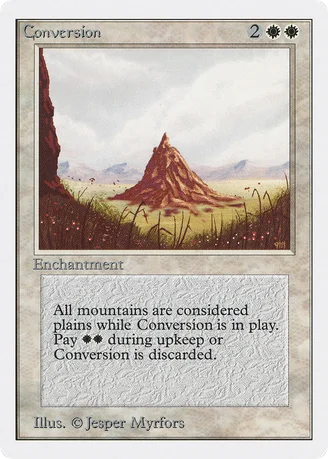
Old school anti-red, this could also combo well with Sunglasses of Urza in a R/W deck
jfre81
☆☆☆☆☆ (0.0/5.0)
With a card like this, it's amazing there were next to no creatures that naturally had plainswalk.
If this is out at the same time as Blood Moon then do all nonbasic lands become plains? Just curious.
strider24seven
☆☆☆☆☆ (0.0/5.0)
@jfre81 The short answer: all nonbasic lands and all Mountains would become Plains.
The long answer: 613.7. Within a layer or sublayer, determining which order effects are applied in is sometimes done using a dependency system. If a dependency exists, it will override the timestamp system.
613.7a An effect is said to "depend on" another if (a) it's applied in the same layer (and, if applicable, sublayer) as the other effect (see rules 613.1 and 613.3); (b) applying the other would change the text or the existence of the first effect, what it applies to, or what it does to any of the things it applies to; and (c) neither effect is from a characteristic-defining ability. Otherwise, the effect is considered to be independent of the other effect.
613.7b An effect dependent on one or more other effects waits to apply until just after all of those effects have been applied. If multiple dependent effects would apply simultaneously in this way, they're applied in timestamp order relative to each other. If several dependent effects form a dependency loop, then this rule is ignored and the effects in the dependency loop are applied in timestamp order.
Both the effects of Blood Moon and Conversion apply in the 4th Layer, and Conversion is dependent on Blood Moon, so timestamp order is overridden. So we apply Blood Moon first, making all nonbasic lands into Mountains, and then we apply Conversion, turning all Mountains (including the former nonbasic lands) into Plains.
Comments (4)
If this is out at the same time as Blood Moon then do all nonbasic lands become plains? Just curious.
The short answer: all nonbasic lands and all Mountains would become Plains.
The long answer:
613.7. Within a layer or sublayer, determining which order effects are applied in is sometimes done using a dependency system. If a dependency exists, it will override the timestamp system.
613.7a An effect is said to "depend on" another if (a) it's applied in the same layer (and, if applicable, sublayer) as the other effect (see rules 613.1 and 613.3); (b) applying the other would change the text or the existence of the first effect, what it applies to, or what it does to any of the things it applies to; and (c) neither effect is from a characteristic-defining ability. Otherwise, the effect is considered to be independent of the other effect.
613.7b An effect dependent on one or more other effects waits to apply until just after all of those effects have been applied. If multiple dependent effects would apply simultaneously in this way, they're applied in timestamp order relative to each other. If several dependent effects form a dependency loop, then this rule is ignored and the effects in the dependency loop are applied in timestamp order.
Both the effects of Blood Moon and Conversion apply in the 4th Layer, and Conversion is dependent on Blood Moon, so timestamp order is overridden. So we apply Blood Moon first, making all nonbasic lands into Mountains, and then we apply Conversion, turning all Mountains (including the former nonbasic lands) into Plains.