My opinion:
The rulings could use a better example. For instance, a player at 4 life would lose 2 life since 4/3 = 1.3333 repeating. By "rounding up" I would think they mean finding the least whole number greater than or equal to 1.3333 repeating, which is 2. This example makes it more clear that you do not round to the nearest whole number (5 would result in a loss of 2 with either operation, so it is a bad example).
Again, this is just a player's interpretation so believe it at your own expense.
DaaNz
☆☆☆☆☆ (0.5/5.0)(1 vote)
the next station is: Pox Hill
Gako
★★★☆☆ (3.8/5.0)(3 votes)
I want a reprint... PLEASE!?
Kryptnyt
★★★★★ (5.0/5.0)(1 vote)
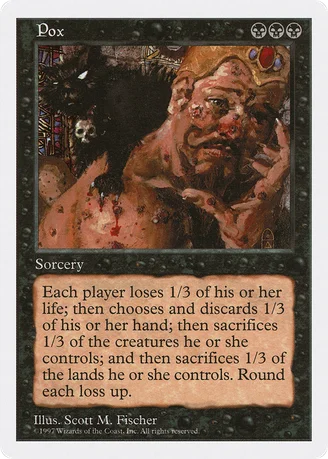
I love the kitty in the artwork. Just randomly scratching the plagued jester dude's back. Gako, they probably won't reprint this, but they occasionally reprint throwbacks. See Smallpox and Death Cloud.
marmaris74
☆☆☆☆☆ (0.0/5.0)
@Arvesius While what you said is true, both the card and the ruling clearly say "round up." So your comment is not needed.
Aw... don't be sad, Mustacheman! Skullcat can only take what you let him take!
blurrymadness
☆☆☆☆☆ (0.0/5.0)
Use when you have a clean third (0,3,6) and when your opponent does not (1,4,7.)
Why? Because the rounding up means you'll lose 1/3rd but they'll lose between 42-50%, and that huge difference in symmetrical cost will cause massive card advantage for you.
For instance, playing 2 cards per turn means that on T3 you'll be at 3 swamps and 3 cards in hand when you cast this, which means you'll lose a creature, a land, and a card in hand.
Your opponent however will lose 2-3 cards in hand, will lose a creature, and 1-2 lands; a 4-7 cards loss. This means you either 3-for-4 them or 3-for-7 them. It also pushes you towards a win-con, which is a big deal. Small Pox works nicely as well. Consider recurring creatures in your deck (Nether Traitor is a good start) and things that dodge this (Bloodchief ascension, artifacts, quest for the nihil stone, nihilith) and creatures that benefit from it (Tombstalker)
MightyPox
☆☆☆☆☆ (0.0/5.0)
I really dig the art of this version. Unfortunately it is not available with black border (yet).
Comments (9)
The rulings could use a better example. For instance, a player at 4 life would lose 2 life since 4/3 = 1.3333 repeating. By "rounding up" I would think they mean finding the least whole number greater than or equal to 1.3333 repeating, which is 2. This example makes it more clear that you do not round to the nearest whole number (5 would result in a loss of 2 with either operation, so it is a bad example).
Again, this is just a player's interpretation so believe it at your own expense.
Gako, they probably won't reprint this, but they occasionally reprint throwbacks. See Smallpox and Death Cloud.
While what you said is true, both the card and the ruling clearly say "round up." So your comment is not needed.
Why? Because the rounding up means you'll lose 1/3rd but they'll lose between 42-50%, and that huge difference in symmetrical cost will cause massive card advantage for you.
For instance, playing 2 cards per turn means that on T3 you'll be at 3 swamps and 3 cards in hand when you cast this, which means you'll lose a creature, a land, and a card in hand.
Your opponent however will lose 2-3 cards in hand, will lose a creature, and 1-2 lands; a 4-7 cards loss. This means you either 3-for-4 them or 3-for-7 them. It also pushes you towards a win-con, which is a big deal. Small Pox works nicely as well. Consider recurring creatures in your deck (Nether Traitor is a good start) and things that dodge this (Bloodchief ascension, artifacts, quest for the nihil stone, nihilith) and creatures that benefit from it (Tombstalker)